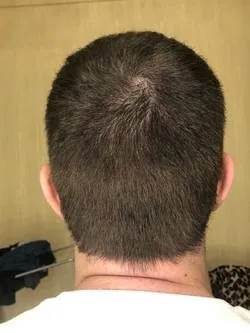
How many grafts each Norwood stage needs
In short: stage 2 needs 500–1,500 grafts, stage 3 1,000–2,500, stage 4 2,000–3,500, stages 5–6 from 3,000 to 6,500, and stage 7 from 5,000 up. These are the ranges the graft calculator above uses. Your real number depends on donor density, hair thickness and how low you want the hairline.
| Stage | What it looks like | Grafts |
|---|---|---|
| Norwood 1 | Almost no loss | no transplant needed |
| Norwood 2 | Small recession at the temples | 500–1,500 |
| Norwood 3 | Deep temples, M-shaped hairline | 1,000–2,500 |
| Norwood 4 | Temples plus a thinning crown | 2,000–3,500 |
| Norwood 5 | A thin bridge between front and crown | 3,000–5,000 |
| Norwood 6 | No bridge, front and crown merged | 4,000–6,500 |
| Norwood 7 | Only a band of hair at the sides and back | 5,000–8,000+ |
Norwood 3: how many grafts
Usually 1,000–2,500. It is the most common stage for a first transplant: the work is mostly at the front and the donor area usually has plenty left.
Norwood 4: how many grafts
2,000–3,500 to cover both the front and the middle. That was my stage — I had 3,500 grafts in one session.
Norwood 5 and above
More than 3,000 grafts, and often more than can be taken safely in one go. The plan matters most here: what to do first and what to leave for later.
A graft is not a hair
A graft is a group of 1–4 hairs growing from one point. So 3,000 grafts means two to three times as many hairs. When clinics compare prices “per hair” and “per graft”, they are talking about different things.
Why the donor area decides everything
Grafts come from the back and sides of the head — that is the donor area. It does not grow back: what is taken is gone for good. Spend too much on the hairline at 25 and there may be nothing left for the crown at 40. That is why the calculator compares what you will need in the end with what your donor area can actually give.
How to use the graft calculator
Pick the head that looks most like yours from above. The numbers on the right update straight away. Then refine the donor area, how fast you are losing hair and your hair type — each step narrows the range. If you only want to restore the hairline, open “Which zones to restore” and untick the rest.
The calculator shows two numbers. The first is how many grafts you need for what you see in the mirror today. The second is for the pattern you are likely to reach in the coming years. Clinics usually quote only the first one.
Density: how many grafts per square centimetre
A graft count means nothing until you know the area it is spread over. Two thousand grafts on a small frontal zone give thick hair; the same two thousand across the front and the crown give see-through fuzz.
Natural density on a healthy head is around 60–100 follicular units per square centimetre. In a transplant, clinics usually place 30–45 grafts per cm²: packing them tighter in one go is risky and some grafts may not survive. Above 50 is rare and usually only on the hairline, where density shows the most. That is why a transplant almost never brings back the density you had at 18. It brings back the look of thick hair — the eye is satisfied with roughly half the original density, especially with coarse or curly hair.
Ask a clinic not only “how many grafts” but “over what area and at what density”. If 1,500 grafts are promised for 60 cm², that is 25 per cm² — thin, and the result will probably disappoint you.
The “pocket” and the frontal forelock
The pocket is the area between a receded hairline and a thinning crown. It is one of the last zones to go and it eats the most grafts, because the surface is large. The forelock is the tuft of hair left at the front in the middle of the recession. It looks solid, but it grows from the same hormone-sensitive hairs and thins out in time, so surgeons usually count grafts as if it were already gone.
My case: stage 4 and 3,500 grafts
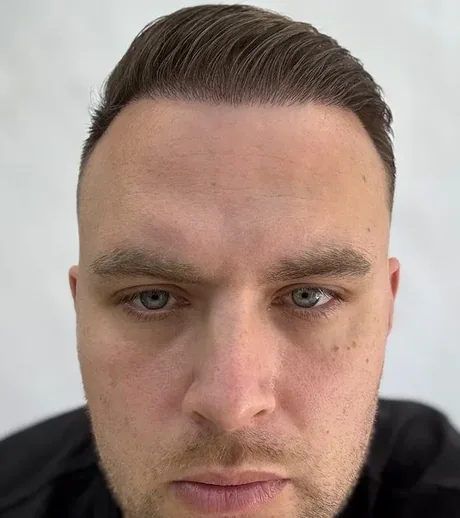
In 2020 I had FUE in Istanbul, 3,500 grafts in one session. How it looked month by month and after 6 years is in My hair transplant experience. What it cost, receipt included, is in Hair transplant cost in Turkey.
Graft questions
How many grafts can be transplanted in one session?
Usually no more than 3,500–4,000. If you need more, the work is split into two sessions.
How many grafts can be taken in a lifetime?
It depends on donor density: on average 5,000–8,000 with FUE. Only an exam under a trichoscope gives an exact number.
Is 3,000 grafts a lot?
For stage 4 it is a normal amount; for stage 2 it is too much. What matters more is how much donor is left afterwards.
What matters more: the number of grafts or the density?
Density. The same grafts can be spread thinly over a large area or packed into a small one. Ask not only “how many grafts” but “what density per square centimetre, over what area”.
How many grafts per cm² is normal?
30–45 grafts per square centimetre. That is about half your natural density, but it still looks thick. Below 25 the scalp shows through.
Can a clinic quote more grafts than I need?
It can. The more grafts, the higher the package price. Compare the clinic's number with this calculator and ask why theirs is different.
Does finasteride change the estimate?
Yes. While the medication works the loss moves more slowly, so the second number — the final one — comes out lower. Stop taking it and the forecast goes back up. Medication is prescribed by a doctor, not by a calculator.
Does the calculator replace a doctor's exam?
No. It is a guide so you walk into a clinic understanding the numbers. The exact graft count is set by a doctor after an exam.
Has a clinic quoted you a different number of grafts? Message me on Telegram — I’d like to compare, and I’ll tell you whether it sounds right.