PRP After a Hair Transplant: My 6-Year Experience
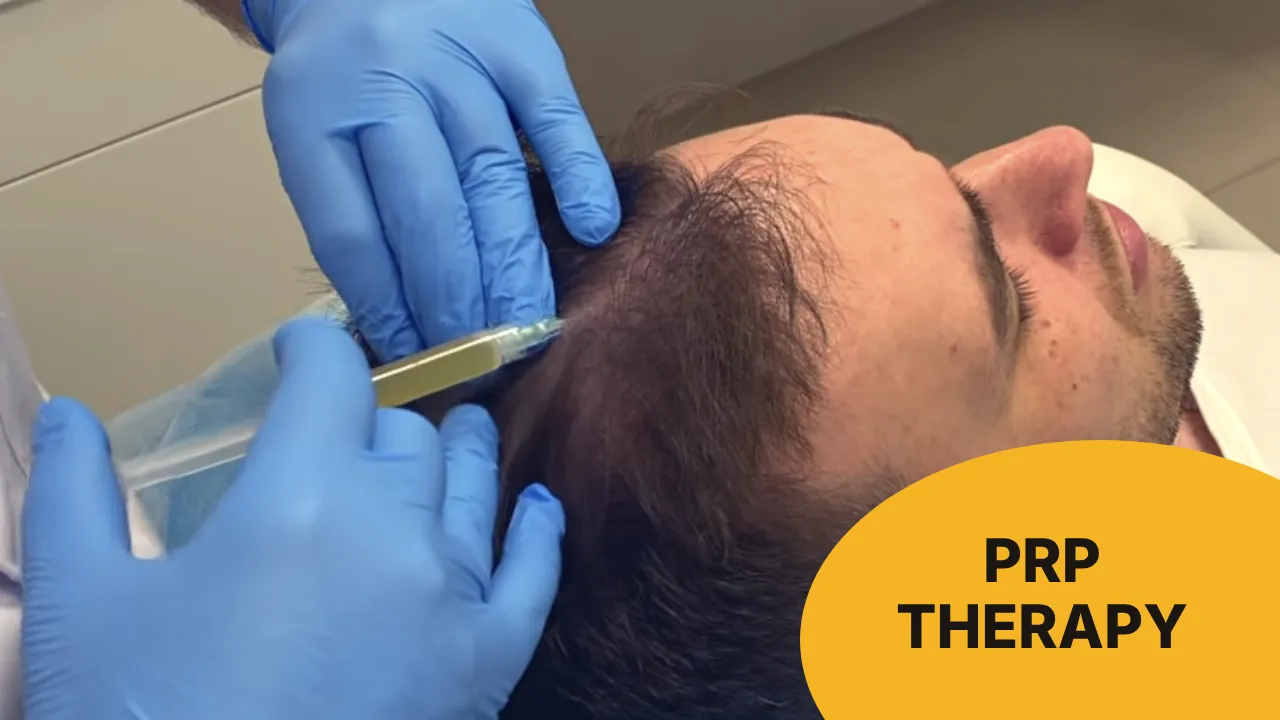
This is PRP: plasma is injected into the scalp with micro-injections
My name is Denys. Six years have passed since my FUE transplant in Istanbul (July 2020), and for all of that time I have been doing PRP after the hair transplant, platelet-rich plasma therapy for the scalp. I had 5 sessions in the first year and now do 2–3 a year. In this article I tell you how it goes for me, what I feel and what I have noticed. I also collected what the research says.
The main thing about my experience: after the sessions my hair feels thicker and denser, and it is the only part of my aftercare where I see a difference myself. But that is my impression, not proof.
I am not a doctor. This is my personal experience, not medical advice or a recommendation. Decide about PRP together with your doctor.
What PRP is, in plain words
PRP stands for platelet-rich plasma. They take your own blood, spin it in a centrifuge, and it separates into layers. The layer rich in platelets is carefully collected and injected back into the scalp.
Platelets contain growth factors. They are believed to help the skin and the hair follicles recover. This is not stem cells and not a foreign substance: it is your own blood.
My PRP schedule after the hair transplant: 5 sessions in the first year
- The first one was during the transplant itself. The clinic told me that plasma helps wounds heal better, which is why they always do it during a transplant.
- After that at months 3, 6, 9 and 12. That is 5 in the first year.
- Now 2–3 sessions a year.
I picked the 3-month interval the way it was offered to me and the way it suited me. I don't push my schedule on anyone: clinics use different ones.
What was happening to the hair itself during that time, from the shedding in month two to full density by the end of the year, is in a separate guide: hair transplant month by month.
How I chose where to do PRP
In the first year I lived in Kyiv and had all my sessions with one specialist. That was about 5 years ago, and I chose a cheap, budget clinic: it came to about $50 a session, while other places were asking $100–150 at the time. Prices are different now. It turned out to be a good choice: the work was good, I was very happy and went only to him, even when I worked abroad.
Important: I did not choose by equipment and I don't understand the tubes and devices, so I won't give technical advice. If it is your first PRP, simply ask the specialist how exactly they prepare the plasma and how much one session costs without any "packages". These are general questions, not a scheme I have tested.
When to do PRP after a transplant and how many sessions
I can only tell you how it was for me: the first session on the day of surgery, then every 3 months during the year. After the first year I moved to 2–3 sessions a year, by intuition and not by anyone's timetable. How many sessions you need and when to start is for your doctor or clinic to decide.
In the studies I found, a different schedule is usually described for PRP without surgery: about 3 sessions roughly a month apart, then maintenance sessions. That only describes how it is done in research papers; it is not advice. According to my sources there is no single schedule that everyone agrees is the best.
How the procedure goes
There is no anaesthesia. Step by step:
- They draw blood from a vein in your arm. Left or right, it doesn't matter.
- The blood is spun in a centrifuge for about 10 minutes.
- The needed part of the plasma is injected into the scalp with micro-injections, bit by bit across the whole hair-bearing area.
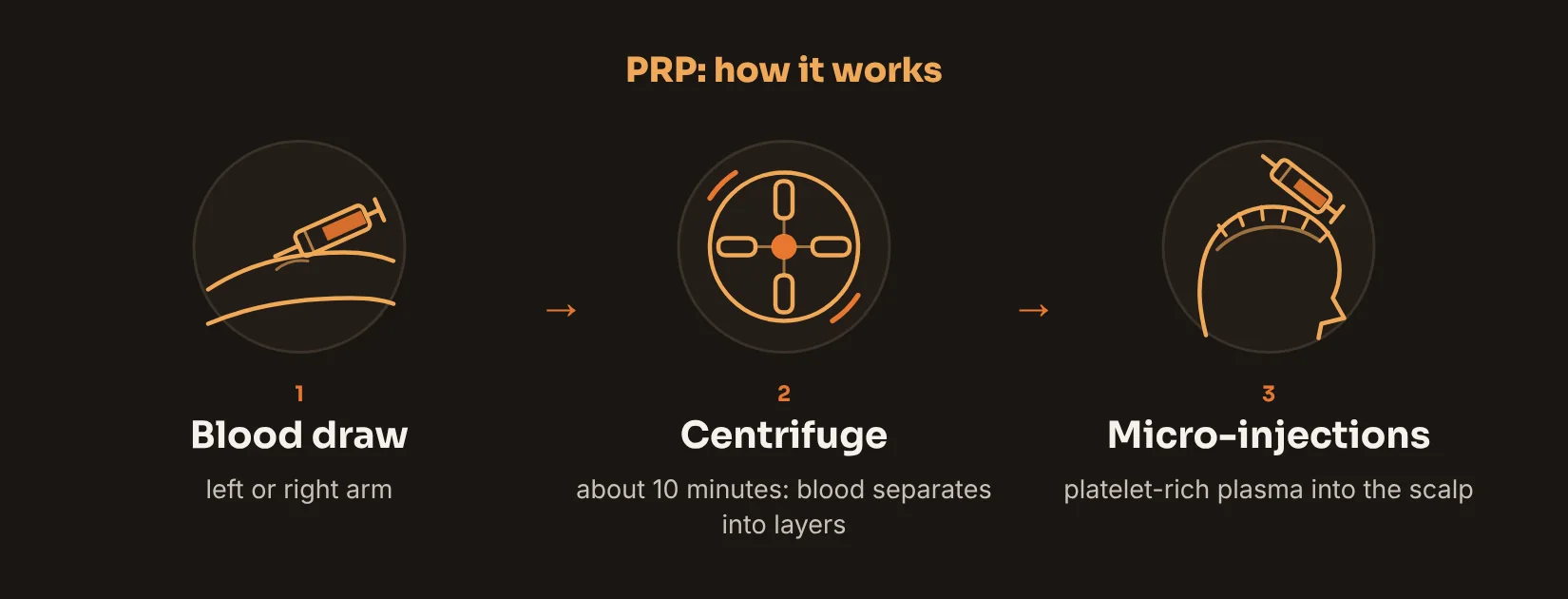
The three steps of the procedure
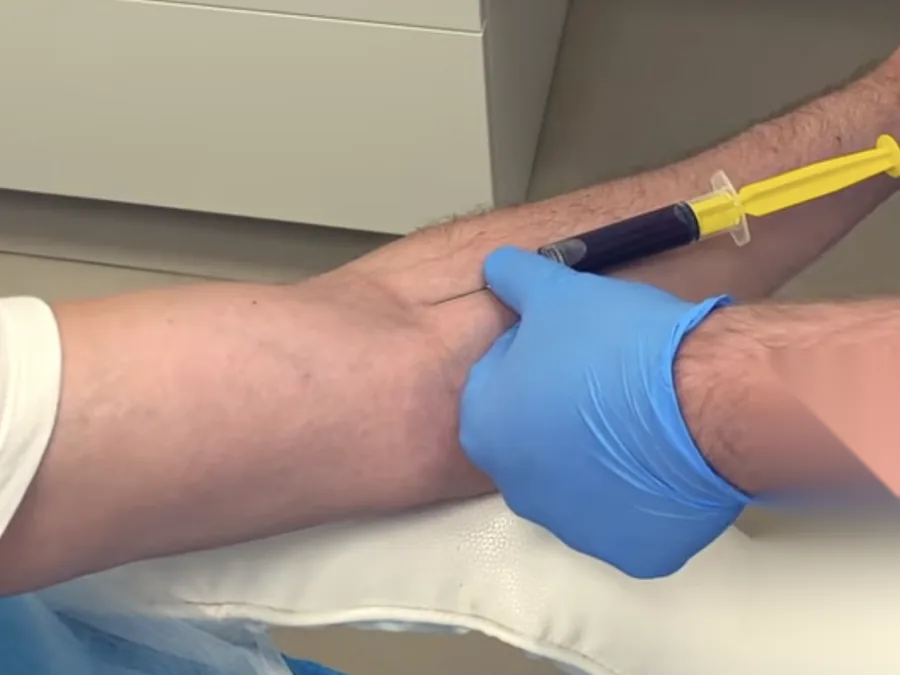
Step 1: blood is drawn from a vein, like a regular blood test
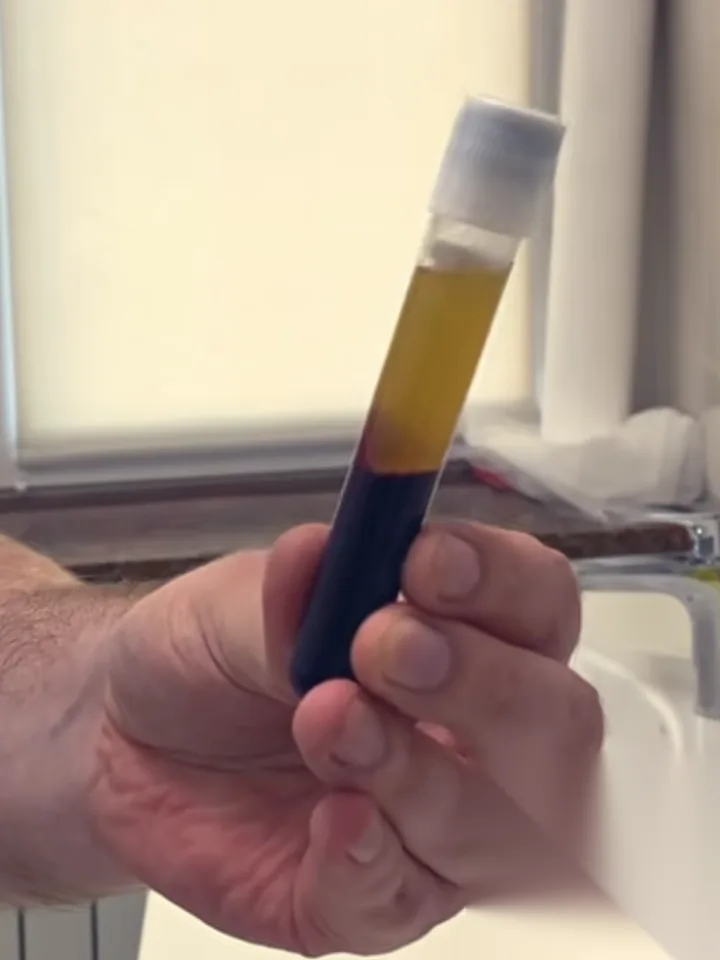
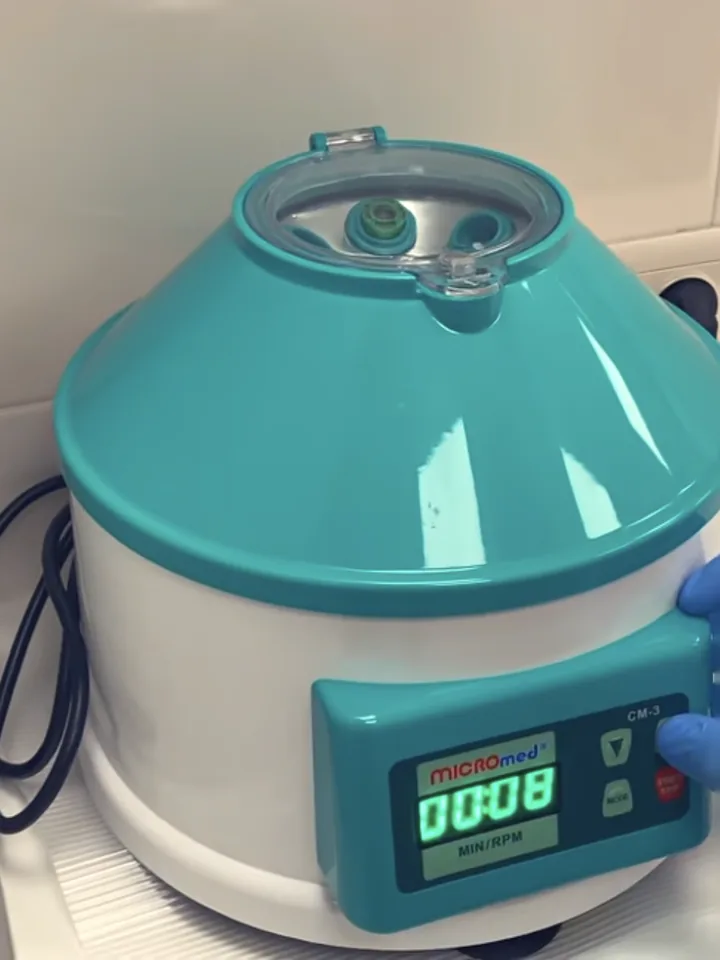
Step 2: 10 minutes in the centrifuge and the blood separates into layers
It is unpleasant. Whether it hurts depends on your pain threshold: for some it is bearable, for some it hardly hurts. For me it is "unpleasant", but you get used to it.
By the way, PRP can also be done before a transplant, and I don't see anything wrong with that. But that is for you to decide with your doctor.
How long it takes and what you can do afterwards
The whole visit takes about 30 minutes. After that:
- you can drive, go home and go about your day;
- it is better not to do sport right away;
- I wash my hair the next day. If the session is in the daytime, you can already wash in the morning;
- you can go to work the next day, and the tiny punctures are barely visible under the hair. It is not as noticeable as after a transplant.
What I feel afterwards
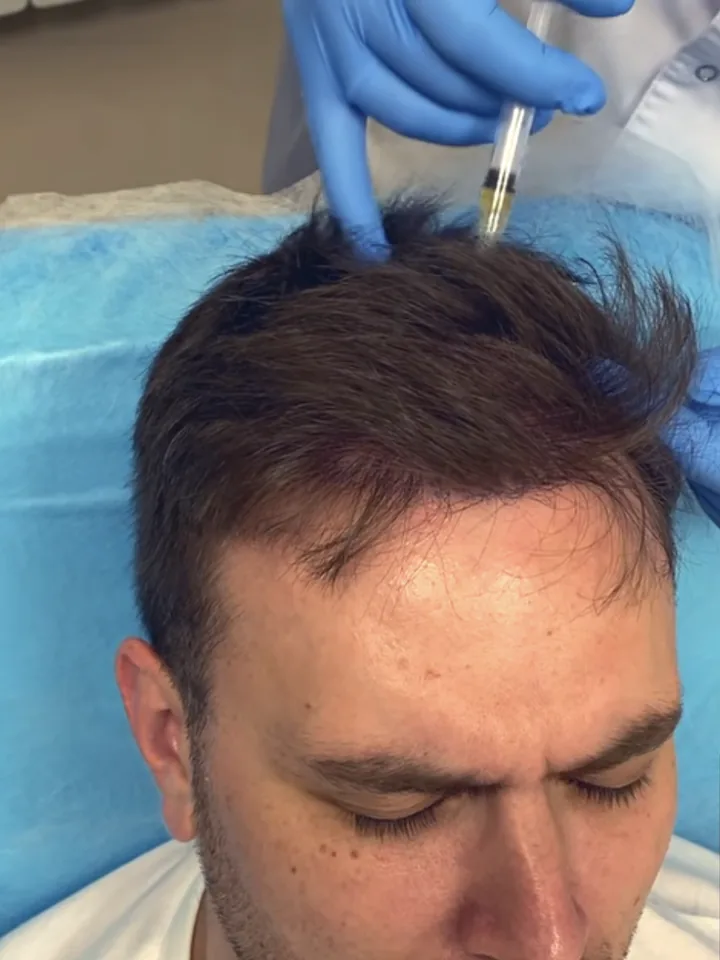
The injections go across the whole hair-bearing area
- I never had scabs. No redness either.
- They don't recommend washing your hair on the first day because of the tiny punctures.
- By the second day nothing hurts and I feel nothing. No itching, no sensitivity of the skin.
- I have never had hair fall out after a session.
That is how it was for me. Other people may react differently, so always ask the specialist doing the procedure for their instructions.
What I noticed over 6 years
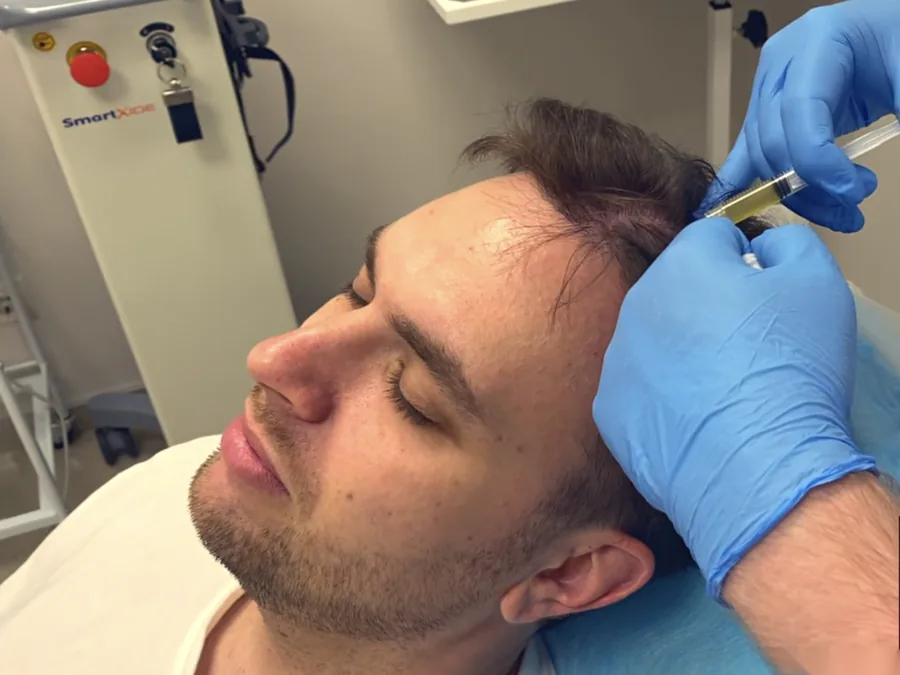
Injections along the hairline during one of the sessions
The main thing about PRP after my hair transplant: my hair feels thicker and denser. I don't have "before" and "after" photos for PRP specifically, so I can't prove it. It is my impression.
A few friends whom I advised to try plasma told me they noticed an improvement too. Those are stories from acquaintances, not a study.
I did have shock loss after the transplant, and I described it in detail in the article about my operation. I don't connect it with plasma.
Not sure whether you need PRP at all, or how many sessions? We can discuss your case: consultation — €49 →
Why PRP may help, according to descriptions
I explain in my own words what reviews and clinic websites say about it. This is not my conclusion but a general explanation, and the exact mechanism is not fully proven.
Platelet-rich plasma contains growth factors: substances that "tell" skin cells it is time to repair and divide. It is believed that around the hair follicles this improves nutrition and blood supply, and the follicles get more signals to grow. For the scalp this sounds logical, but the evidence is modest, and I describe it below.
Separately, there is healing after the transplant. The clinic told me plasma helps wounds heal better, which is why it is done during the surgery. That is what the clinic said, not something I checked.
Why I don't do 7 sessions at once
Doctors and clinics often offer a package: for example 7 sessions, and it comes out cheaper that way. That approach doesn't suit me. I think clinics, of course, like to sell a package.
I do it 2–3 times a year and I think that is enough for me. That is my case, by intuition and not by anyone's scheme. For me it matters that it doesn't hit the wallet and that the number of sessions is moderate. I have no exact deadline, and when I postponed a session I noticed nothing bad. That is about me; it can be different for others.
Why I keep doing PRP 2–3 times a year
Not only for the hair. In my feeling, plasma is good for the scalp itself: as I understand it, it improves circulation, and I have no dandruff. These are my own observations, and I have no studies that confirm them.
I also don't take minoxidil or finasteride. No doctor told me not to, it is my decision: I simply don't want to take them. What I take instead I described in the article about vitamins.
If I were starting over, I would change nothing.
Does PRP work: an honest answer from a patient
The honest answer: I think yes, it helps me, but the scientific evidence is modest.
What I found in the sources:
- Large reviews of PRP for androgenetic alopecia (without surgery) show a small gain in hair density. The quality of evidence is rated as not high, and results differ a lot between studies. For example, a 2024 meta-analysis rated the quality of evidence as low, while a 2025 review speaks of moderate evidence.
- The American Academy of Family Physicians writes that PRP for hair loss is used "off-label", meaning the FDA has not approved it for this. No serious side effects were noted in the reviews. This is the AAFP review.
- There is even less data on PRP together with a transplant. In a small 2024 study (30 patients, FUE), graft survival at 3 months was higher in the PRP group. But the sample is small, the follow-up was only half a year, and all participants were also on hair-loss medication.
- What science does not know yet: the best protocol (how many platelets, how many sessions, what intervals), the effect beyond a year and, most importantly, large studies specifically on PRP after a transplant.
That is why I don't say "PRP will save your hair". I say: over 6 years things went well for me, and I feel that plasma helps with that.
Who should talk to a doctor first
I can't tell you whether PRP is right for you. According to the sources I read, you should discuss it with a doctor before the procedure if you:
- take blood thinners or have clotting problems;
- are pregnant or breastfeeding;
- have inflammation or an infection of the scalp;
- may be losing hair for another reason, for example a thyroid problem.
This is not a complete list and not medical advice. Your doctor will explain the details.
What people get wrong about PRP
- "It is stem cells." No. These are platelets from your own blood.
- "It works in 90% of cases." I did not find that number in scientific sources, so I don't repeat it.
- "It is a magic pill." The effect in studies is modest, and a placebo effect can't be excluded. I feel that plasma helps, but I have no proof.
How much it costs
Prices vary a lot. In the first year in Kyiv, 5 years ago, I paid about $50 a session at a budget clinic. Now I live in Europe, and the price here depends on the clinic: roughly $165 to $440 a session. I wrote about prices and what my first year cost in the article about the cost of a transplant.
FAQ
PRP therapy for hair: how it goes
I am not a doctor and I write only about my own experience. I have no sponsors, and the links in this article are not affiliate links.
Read also: how my operation went, what I take after the transplant, how to choose a clinic and how much a transplant in Turkey costs.
Want to go through your own situation?
I'll tell you what I did myself and help you prepare questions for the clinic and avoid paying for things you don't need. This is personal experience, not medical advice.
Book a consultation — €49